Nov 7, 2014

Interview with Dr. Stephen Bramer

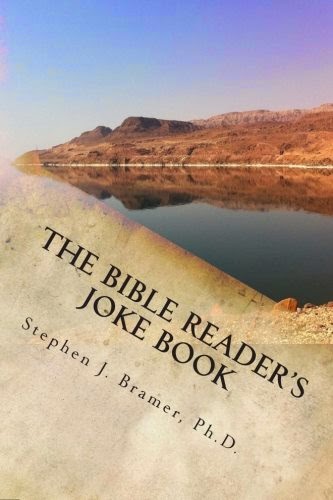
I am delighted to be able to interview my friend Dr. Stephen Bramer. He chairs the Bible Exposition Department at Dallas Theological Seminary. Dr. Bramer is also a teaching pastor at Waterbrook Bible Fellowship in Wylie, Texas and speaks and travels extensively both nationally and internationally. He recently published The Bible Reader’s Joke Book and graciously agreed to answer a few questions about this latest project.

1. You have been working on this project for some time. Can you tell us how you got started?

When I first began to teach in Bible College in the early ‘80’s I began to write some jokes in the margins of my lecture notes. When I used them in my classes I found it helped develop a rapport with the students so I continued to use them and add to them year after year. When I got my first computer in the early ‘90’s I began to collect all my jokes in a document. Finally, after a couple of decades, I have now published the collection so that others in ministry can have access to them.

2. There are number of books containing jokes that have been published and an internet sites that also are a source of jokes. What makes your book different and how is it potentially more helpful?

All joke books and internet humor sites that I have seen have collected jokes topically. The Bible Reader’s Joke Book is unique in that the jokes a categorized according to the 66 biblical books. So if you are leading a Bible study in 1 Timothy all you need to do is turn in this joke book to the section on 2 Timothy and there are pages of jokes related to the material of this biblical book. This saves time which is in short supply I find in the ministry. I have found my jokes in many different sources but the difference is that they are now attached to a specific passage or verse. I have included a fairly extensive topical index at the back so if the joke say on marriage in Gen 2:24 is not one you want to use the user can consult the index to find other jokes on marriage such as those in Song of Solomon. This resource is available in both paperback and kindle which allows the user to choose the best format for their personal use.

3. Effective speakers understand the potential value of humor but do you see humor in the Bible itself?

The Bible itself is dealing with serious issues including our salvation. Many times the author is dealing with disobedient followers or false teachers/prophets. This doesn’t lend itself to humor! In fact you wouldn’t expect a great deal of humor is a theology or discipleship manual either. In addition, much of the content is condensed from how it might have originally been delivered orally so there are few illustrations etc. However, when the donkey speaks or Jesus uses the humorous illustration of the camel trying to go through the eye of a needle it shows me that humor is not unbiblical and can be used with profit. In the process of now transferring the biblical material to a modern audience and having maybe a half hour to orally present, what might only take 5 minutes to read, gives the speaker today the opportunity to include humor.

4. While using humor is helpful, are there kinds of humor and certain occasions when you don’t think it is appropriate. 


In my introductory pages I have a page titled “Read this First, before you Use this Tool!” Anyone who purchases a tool finds such a page in the owner’s manual since any tool can be misused. The audience, the subject matter, the occasion, all can indicate that humor may not be appropriate. If the speaker’s goal is to communicate then the communicator must be careful not to say anything that would hinder this. And yet, in certain situations, with a particular audience on a specific topic, humor is of tremendous help in communication.

5. What advice would you give to young preachers and teachers on how to best use this book? 

  I would encourage young (and older!) preachers and teachers to use this resource like many of their other resources. Have it on your desk and consult it when you are preparing a message. In keeping with your personality, your need and the availability of a joke use it as appropriate.

You can purchase The Bible Reader’s Joke Book in print or Kindle versions using this Amazon link.

Nov 6, 2014

Latest Issue of Review of Biblical Literature

The latest issue of Review of Biblical Literature is out. Reviews can be accessed by clicking the links below. 

Walter Brueggemann
The Practice of Prophetic Imagination: Preaching an Emancipating Word
http://www.bookreviews.org/bookdetail.asp?TitleId=8481
Reviewed by Leonard Mare

Michael H. Burer
Divine Sabbath Work
http://www.bookreviews.org/bookdetail.asp?TitleId=8894
Reviewed by Margaret Daly-Denton

Timo Eskola
Beyond Biblical Theology: Sacralized Culturalism in Heikki Räisänen's Hermeneutics
http://www.bookreviews.org/bookdetail.asp?TitleId=9519
Reviewed by Vernon K. Robbins

Irmtraud Fischer and Mercedes Navarro Puerto, eds., with Andrea Taschl-Erber
Torah
http://www.bookreviews.org/bookdetail.asp?TitleId=8382
Reviewed by Elaine T. James

Philip Goodwin
Translating the English Bible: From Relevance to Deconstruction
http://www.bookreviews.org/bookdetail.asp?TitleId=9224
Reviewed by Stephen Pattemore

George Anton Kiraz
The New Syriac Primer: An Introduction to The Syriac Language
http://www.bookreviews.org/bookdetail.asp?TitleId=9453
Reviewed by H. F. van Rooy

Aaron J. Koller
The Semantic Field of Cutting Tools in Biblical Hebrew: The Interface of Philological, Semantic, and Archaeological Evidence
http://www.bookreviews.org/bookdetail.asp?TitleId=9157
Reviewed by Stephen J. Bennett

Zhixiong Niu
“The King Lifted up His Voice and Wept”: David’s Mourning in the Second Book of Samuel
http://www.bookreviews.org/bookdetail.asp?TitleId=9549
Reviewed by David G. Firth

Mark Allan Powell
Jesus as a Figure in History: How Modern Historians View the Man from Galilee
http://www.bookreviews.org/bookdetail.asp?TitleId=9260
Reviewed by Brian C. Small

Emmanuel L. Rehfeld
Relationale Ontologie bei Paulus: Die ontische Wirksamkeit der Christusbezogenheit im Denken des Heidenapostels
http://www.bookreviews.org/bookdetail.asp?TitleId=8856
Reviewed by Lars Kierspel

Nov 5, 2014

Babylon Links

One of my favorite bloggers is Ferrell Jenkins at Ferrel's Travel Blog. If you are interested in the intersection points between the Bible, the Holy Lands, and archaeology, this blog might be for you. Every now and again, Ferrell produces a topical index of links related to posts on his blog. A case in point are the links related to Babylon here. If you are preaching or teaching in a book or passage that relates to Babylon you will want to check it out.

Nov 4, 2014

Options for Preaching the Bigger Books of the Bible

Peter Mead offers some options for preaching bigger books of the Bible here. While I do think that, all things being equal, we should preach even the bigger biblical books expositorily and consecutively, there might be occasions where this is not possible or advisable. In such cases, these other options are worth considering. 

Nov 3, 2014

Plummer on Louw & Nida

Rob Plummer commented on BDAG last week (here) and this week he offers a brief introduction to Louw & Nida. 

Nov 2, 2014

Free Audio Book: The Attributes of God by A. W. Tozer

Christianaudio.com is offering A. W. Tozer's book, The Attributes of God, Volume 1: A Journey into the Father's Heart, as their free download for the month of November. To read more about the book and to get your free audio download go here.

Oct 31, 2014

Free Audio from the 2014 Advanced Expository Preaching Workshop

Free audio from the 2014 Advanced Expository Preaching Workshop focusing on the book of Jonah has just been posted. You can access the audio page here or click the individual messages below.

Jonah 1 – David Allen

Jonah 2 – Steven Smith

Jonah 3 – Vern Charette

Jonah 4 – Matt McKellar


You can also access notes from David Allen's presentation here.

Oct 30, 2014

Preaching Amos

David Allen has another helpful post on preaching. In this case, he makes some helpful comments and observations related to preaching the prophetic book of Amos. You can check it out here.

Oct 29, 2014

Old Testament Tabernacle Resources

Those interested in studying the Old Testament tabernacle might be interested in this website

Oct 28, 2014

Preaching Hebrews . . . from Hebrews

See David Allen's thoughts on "Lessons on Preaching Hebrews . . . from Hebrews" here.

Oct 27, 2014

Rob Plummer on BDAG

Watch this somewhat humorous video discussion on A Greek-English Lexicon of the New Testament and Other Early Christian Literature or what is simply and commonly known as BDAG.


Oct 24, 2014

Learning from Leviticus

Jay Sklar has a nice post on "4 Things That Happen When You Study Leviticus More Than 10 Years" here.

Sklar also has the helpful article "Suggestions for a Sermon/Teaching series on Leviticus" here and some audio here.

HT: David Murray

Oct 23, 2014

A Look at the Occupation of Canaan

The animated video "This Land Is Mine" by Nina Paley has apparently been out for a couple of years but I had never seen it before. It is a semi-dark look at the history of warfare in Canaan. You can access Paley's website which includes some explanation here.


Oct 22, 2014

Review of James the Just

David Friedman and B. D. Friedman, James the Just: Ya’akov Hatzaddik Presents Applications of Torah, Messianic Commentary (Clarksville, MD: Lederer, 2012).  

The commentary at hand is to be commended for attempting to read James and his book in light of a Jewish context. Many students of the New Testament have long recognized that the author James (or Ya’akov as preferred in the commentary) and his work are one of the most Jewish-oriented of the so-called general epistles. The authors contend that James was the chief rabbi of the messianic Jewish community and that the book is best read as a yalkut, a compendium or collection of teachings of a rabbi. They further contend that the book of James is a reflection on Leviticus 19 and perhaps interacting with the Parasha readings associated with this chapter.

This was a difficult “commentary” to evaluate. One problem is that so much of the “commentary” is devoted to the author Ya’akov and less is related to an examination of his book. While an examination of Ya’akov might be helpful (and has been done) much here is ultimately speculative, and even if correct, is only marginally helpful. I am not sure that many serious students of James would deny that he was a chief leader of the Jewish believers in Jerusalem. Additionally, an entire section is devoted to explaining why the Hebrew name Ya’akov was changed to the anglicized James. Not a problem, but the conclusion presented in the book is unwarranted: “this situation is minor, but where else has man changed the truth of the Bible” (p. 8). Now my preference would be to use the name Jacob rather than James, but is using “James” really changing the truth of the Bible? Indeed, the authors might be guilty of this very same thing when they change the divine name YHWH to Adonai (e.g., p.17). I understand that this qere reading is a traditional Jewish practice but should the one who follows a tradition be so critical of others who also follow another tradition?

A reader also gets the sense that using the Hebrew pronunciation of certain words adds authenticity or gravitas to the discussion. It is akin to the equally mistaken assumption held by a previous generation that the KJV’s “thees” and “thous” were somehow more pious than more commonly used pronouns. This mistaken notion also results in textual overkill. Many passages are reproduced in Hebrew/Greek, Hebrew/Greek transliteration, and English. I am not sure what the point is. Those who can read the Hebrew and Greek don’t need the transliteration. Those who can’t really can’t do much with the transliteration other than pronounce it. But pronunciation does not produce meaning. There is a further problem with the Greek and Greek transliteration. The Greek does not include breathing marks or accents and fails to utilize the final sigma at the end of words. The absence of breathing marks is carried over to the transliteration so that the rough breathing “h” is not included and this will affect proper pronunciation.

A methodological problem also relates to the use of the rabbinical traditions often utilized in this work. Namely, there is the potential of anachronistic interpretations. The authors are apparently aware of the possible problem (p. 28) but I am not sure that this awareness really affects the authors’ approach in the use of Jewish sources. 

Finally, if this series intends to reach a broader audience than a Jewish messianic one, then more care will need to be exercised in defining terms. For example, although this volume contains a four-page glossary, some terms such as B’rit Hadesha (p. xv) are not found there. Likewise, less familiar or unfamiliar abbreviations need to be explained or defined (e.g., CJB, p. 17).

In the end, a commentary should be evaluated primarily on how successfully it explains the text in question. Here it is a mixed bag. There are interesting insights here and there but a number of passages are under-discussed and/or ignored altogether. I doubt whether this volume does enough to distinguish it from better, more informative, and balanced commentaries to appeal to more than a niche Jewish messianic audience.

Thanks to Lederer Books for the free review copy used for this review.

Oct 21, 2014

Free Online Journal: Journal of the Jesus Movement in its Jewish Setting

You can access the first volume of the free open-access journal: Journal of the Jesus Movement in its Jewish Setting here. You can also access individual PDF articles here.

HT: Cliff Kvidahl

Oct 20, 2014

The Premier Issue of Expositor Magazine

I recently noted a new bi-monthly publication entitled Expositor here. Having obtained a copy of the premier issue, I am happy to say it is very well done. The production quality is very good. The big guns were called out for this issue with articles by Steven Lawson, John MacArthur, R. C. Sproul, Al Mohler, Sinclair Ferguson, Mark Dever, and others. The articles related to biblical inerrancy and the prophetic word. In the day where many evangelicals are seemingly less committed to inerrancy, one can
appreciate the firm commitment to the inspired and inerrant text expressed in the various articles. That being said, and with that foundation being laid, I hope that future issues will be more devoted to the practice of expository preaching.

You can see the table of contents for the premier issue here and subscribe here.

Oct 19, 2014

Buying a Greek New Testament

Rob Plummer has a good video discussion here on buying a Greek New Testament. Those who are going to ETS or SBL might want to wait about a month to catch these volumes on sale. Plummer also notes, what we have noted before, that Nestle-Aland 28th edition can be accessed in full here.

Oct 18, 2014

St. Luke's Day

In some church traditions, October 18 is designated a feast day for St. Luke. I am not sure exactly how to celebrate the author of Luke-Acts but spending time in one or both books would seem appropriate. After all, Luke probably wrote more of the New Testament (by content) than anyone else.

Oct 17, 2014

Avoiding Parallelomania and Parallelophobia

I have just started looking through Aaron Chalmer's Exploring the Religion of Ancient Israel.In his introductory discussion of ancient Near Eastern texts, he notes two terms which represent ends of a spectrum. The first, parallelomania, has been used in biblical studies since the early sixties (I believe). It is usually attributed to Samuel Sandmel, who attributed it to a French source from 1830 (“Parallelomania,” Journal of Biblical Literature 81 [1962]: 1). The second term, parallelophobia, is as far as I can tell, of a more recent origin. In any case, one encounters both phobias in biblical studies and I think that Chalmer's offers some sound advice concerning the application of ANE texts to the Hebrew Bible. Chalmer's writes,

“When approaching this potential source of evidence, however, we need to walk a path between parallelomania (widespread, uncritical comparison of texts from one society to another), on the one hand, and parallelophobia (general refusal to compare texts from one society with another), on the other. Both approaches can be problematic. Parallelomania often fails to realize that texts must be understood within the original context in which they were produced as surface similarities may, in fact mask deeper differences. Parallelophobia, in contrast, fails to recognize that various people groups of the ANE shared broadly similar intellectual and conceptual world-view, and thus texts may shed light on realities which extended beyond the borders of the society that produced them. Potential problems can be minimized by ensuring that texts are interpreted contextually and that any comparisons that are made are with societies that are as chronologically and geographically close to ancient Israel as possible. When approached responsibly, the use of comparative texts is a very valuable exercise” (Aaron Chalmers, Exploring the Religion of Ancient Israel: Prophet, Priest, Sage and People [Downers Grove, IL: IVP Academic, 2012], 9-10).

Oct 16, 2014

Mark Seifrid's 2 Corinthians Commentary

Eerdmans is offering a three-day sale on Mark Seifrid's brand new 2 Corinthians commentary. You get it at 40% off and free shipping to boot. You have to email Eerdmans directly at sales@eerdmans.com with "3 Day Sale: The Pillar 2 Corinthians Commentary" in the subject line. The sale ends this Saturday, October 18.

Oct 15, 2014

A Glimpse into the life of Ph.D. Students

Tavis Bohlinger provides an interesting glimpse into the life of Ph.D. students here. My own approach was not as regimented as many here but maybe that is why it took me longer than some. In any case, this post does give a good idea of the kind of commitment that is necessary to do a Ph.D. 

Oct 14, 2014

Surveys on the Gospel of Mark

Peter Head has posted a helpful compilation of scholarly survey studies related to the Gospel of Mark here.

Oct 13, 2014

The Bible Reader's Joke Book

http://www.amazon.com/The-Bible-Readers-Joke-Book/dp/1502741202/ref=sr_1_1?ie=UTF8&qid=1412993571&sr=8-1&keywords=The+Bible+Reader%27s+Joke+BookAccomplished preachers, teachers, and speakers, know the value of using humor. My good friend Dr. Stephen Bramer has finally published his collection of over 2,000 biblically related jokes, puns, funny stories, and sayings. What makes this collection particularly useful is that they are arranged bu Bible book and verse. So you can look up a passage and see what is available for that book/chapter/verse. You can check out and purchase The Bible Reader's Joke Book using this link.

Oct 12, 2014

New Mark Commentary

Mark Strauss's new commentary on Mark in the Zondervan exegetical Commentary series is out now. Although I have not obtained a copy yet, I have used the authors Four Portraits, One Jesus and my experience with the ZECNT series has been generally positive. You can access a PDF excerpt here.

Oct 11, 2014

Witherington, Dispensationalism, and the Rapture

The Euangelion Blog recently posted this video by noted New Testament scholar, Ben Witherington III. While the better part of wisdom might suggest ignoring the video outright, I posted the following in the comments section. 
"There are numerous problems here. Let me note a few. First, there appears to be confusion and conflation between Dispensationalism and the rapture (note the title at the top pf the video and then the title later). While Dispensationalists tend to believe in a pretrib rapture, the rapture is but a subset of the theological system. Charles Ryrie has articulated an oft-repeated and accepted list three sine qua non of Dispensationalism. They are: (1) a grammatical-historical hermeneutic (or less technically a normal reading) of Scripture, (2) a distinction between Israel and the Church, and (3) the glory of God as the main purpose or goal of God’s work in the world. Ryrie articulated this perspective in Dispensationalism Today in 1965 (nearly fifty years ago). So critics of Dispensationalism cannot claim that this is a novel or obscure development. Perhaps more importantly, note that the rapture is not listed among Ryrie’s sine qua non.

"Another problem is the assertion that a Dispensational reading of Scripture did not begin until the nineteenth century. While the articulation and formulation of the theology might have relatively modern roots, Dispensationalists would argue that their approach to the Bible was shared by the authors of Scripture and the early church. For example, the idea of a distinction between Israel and the church, Dispensationalist would argue is found in Paul (e.g., Romans 9–11). Furthermore, it is interesting is that Witherington is a Methodist, a theological tradition that is barely older than that of Dispensationalism and also to one degree or another, tied to a revivalist movement. Calvinism is not much older either. This raises a methodological question. For example, am I free to dismiss Amillennialists simply because the early church appears to have been Chiliasts?

"Witherington statements concerning the Scofield Bible are open to challenge. Witherington states that the Scofield Bible contains a heading that reads “Jesus predicts the rapture.” (Witherington does qualify his statement with “like.”) The problem is that I cannot find such a heading any such heading in Scofield. Furthermore, when I do a search for the term “rapture” in Scofield, it only yields two references, both related to Revelation 19. I might add that Witherington’s association of Matthew 24 with the rapture is simply wrong. Most pretribulationist see the bulk of the Olivet Discourse in Matthew 24–25 to relate to the Second Coming and not the rapture. Those that know the pretrib position know that this is an important distinction of pretrib proponents. Furthermore, the off-hand comment related to people confusing notes in a Bible with the actual text of the Bible is unpersuasive if not irrelevant. The same could be said of the notes in the Geneva Bible which predates Scofield by over 400 years. And although it is a more recent vintage, there is even a Wesley Study Bible out there. Will some people confuse the notes with text? Of course.

"Is Witherington’s statement that, “This was a theological movement not based on the study of the Greek New Testament or the Hebrew Old Testament” fair or accurate? It is interesting that Witherington does mention the founding of Dallas Theological Seminary. Here is bit from the website related to the history of DTS: 

“In 1935 the Seminary pioneered the four-year Master of Theology (ThM) degree, which is a year longer than the three-year Master of Divinity (MDiv) offered at most other seminaries. The ThM gives all the essential theological courses offered in a three-year curriculum with additional emphasis in systematic theology, Hebrew and Old Testament exegesis, Greek and New Testament exegesis, and Bible exposition.” 

"Note then from its inception, DTS has required the study of both Hebrew and Greek. Interestingly, a cursory check this morning indicates that the Dallas ThM require 5 semesters of Greek and 4 in Hebrew. Asbury, where Witherington teaches, requires its MDiv students at most 2 semesters of Greek and 2 semesters of Hebrew. Just saying.

"I could go on, but this response is already too long."

By way of conclusion let me state my sincere appreciation for Witherington's work in general. According to Zotero, I have 28 of his books in my personal library and have probably spent the equivalent of a small country's GDP to get them. But I usually consider it a small price to pay for the benefit that I receive. Witherington is no scholarly hack, and so I am especially grieved by this ("wait for it") "hatchet job."