The folks at Southern Seminary have put together these summer reading lists.
HT: Brian Renshaw

May 31, 2014


Samson Trivia
Blane Bachelor's recent article on "The History of Luggage" mentioned this interesting, if somewhat trivial, biblical connection: "Shwayder Trunk Manufacturing Company, which eventually changed its name to Samsonite (a nod to the biblical figure Samson, because of his strength), started making suitcases in addition to their tried-and-true trunks." There is bound to be a sermon illustration here.
May 28, 2014
A Panel Discussion on the Song of Songs
I had not seen this panel discussion held last year at the Harvard Divinity School on the Song of Songs. Video of the discussion can be seen here. The wepage contains the following description.
This panel discussion was held on April 15, 2013, and featured a conversation between five scholars on the Song of Songs. The panel was chaired by CSWR director Francis X. Clooney, S.J., and featured Cheryl Exum of the University of Sheffield, Michael Fishbane of University of Chicago Divinity School, Paul Griffiths of Duke University, and Stephanie Paulsell of HDS.HT: Mark McGinniss
May 27, 2014
Latest Issue of Review of Biblical Literature
The latest issue of Review of Biblical Literature is out. Reviews can be accessed by clicking the links below.
William P. Atkinson
Baptism in the Spirit: Luke-Acts and the Dunn Debate
http://www.bookreviews.org/bookdetail.asp?TitleId=9075
Reviewed by Lars Kierspel
Edward Ball and Margaret Barker, eds.
‘The Unconquered Land’ and Other Old Testament Essays: Selected Studies by Rudolf Smend
http://www.bookreviews.org/bookdetail.asp?TitleId=9232
Reviewed by David J. Reimer
Carol J. Dempsey and Elayne J. Shapiro
Reading the Bible, Transforming Conflict
http://www.bookreviews.org/bookdetail.asp?TitleId=8149
Reviewed by Joel Stephen Williams
Desiderius Erasmus; Andrew J. Brown, ed.
VI-4 Ordinis sexti tomus quartus: Novum Testamentum ab Erasmo Recognitum, IV, Epistolae Apostolicae (secunda pars) et Apocalypsis Iohannis
http://www.bookreviews.org/bookdetail.asp?TitleId=9141
Reviewed by Jerome A. Lund
Shimon Gesundheit
Three Times a Year: Studies on Festival Legislation in the Pentateuch
http://www.bookreviews.org/bookdetail.asp?TitleId=8838
Reviewed by William A. Tooman
Francisco Lozada Jr. and Greg Carey, eds.
Soundings in Cultural Criticism: Perspectives and Methods in Culture, Power, and Identity in the New Testament
http://www.bookreviews.org/bookdetail.asp?TitleId=9154
Reviewed by Earl Kellett
Matthew R. Malcolm
The World of 1 Corinthians: An Exegetical Source Book of Literary and Visual Backgrounds
http://www.bookreviews.org/bookdetail.asp?TitleId=9337
Reviewed by Bradley J. Bitner
Kathleen M. Rochester
Prophetic Ministry in Jeremiah and Ezekiel
http://www.bookreviews.org/bookdetail.asp?TitleId=8537
Reviewed by Georg Fischer
Karlheinz Schüssler
Das koptisch-sahidische Johannesvangelium sa 506 aus dem Jeremia-Kloster von Sakkara: mit Textvarianten der Handschriften in Barcelona, Cairo, Dublin, Naqlun, New York
http://www.bookreviews.org/bookdetail.asp?TitleId=9388
Reviewed by Johanna Brankaer
William P. Atkinson
Baptism in the Spirit: Luke-Acts and the Dunn Debate
http://www.bookreviews.org/bookdetail.asp?TitleId=9075
Reviewed by Lars Kierspel
Edward Ball and Margaret Barker, eds.
‘The Unconquered Land’ and Other Old Testament Essays: Selected Studies by Rudolf Smend
http://www.bookreviews.org/bookdetail.asp?TitleId=9232
Reviewed by David J. Reimer
Carol J. Dempsey and Elayne J. Shapiro
Reading the Bible, Transforming Conflict
http://www.bookreviews.org/bookdetail.asp?TitleId=8149
Reviewed by Joel Stephen Williams
Desiderius Erasmus; Andrew J. Brown, ed.
VI-4 Ordinis sexti tomus quartus: Novum Testamentum ab Erasmo Recognitum, IV, Epistolae Apostolicae (secunda pars) et Apocalypsis Iohannis
http://www.bookreviews.org/bookdetail.asp?TitleId=9141
Reviewed by Jerome A. Lund
Shimon Gesundheit
Three Times a Year: Studies on Festival Legislation in the Pentateuch
http://www.bookreviews.org/bookdetail.asp?TitleId=8838
Reviewed by William A. Tooman
Francisco Lozada Jr. and Greg Carey, eds.
Soundings in Cultural Criticism: Perspectives and Methods in Culture, Power, and Identity in the New Testament
http://www.bookreviews.org/bookdetail.asp?TitleId=9154
Reviewed by Earl Kellett
Matthew R. Malcolm
The World of 1 Corinthians: An Exegetical Source Book of Literary and Visual Backgrounds
http://www.bookreviews.org/bookdetail.asp?TitleId=9337
Reviewed by Bradley J. Bitner
Kathleen M. Rochester
Prophetic Ministry in Jeremiah and Ezekiel
http://www.bookreviews.org/bookdetail.asp?TitleId=8537
Reviewed by Georg Fischer
Karlheinz Schüssler
Das koptisch-sahidische Johannesvangelium sa 506 aus dem Jeremia-Kloster von Sakkara: mit Textvarianten der Handschriften in Barcelona, Cairo, Dublin, Naqlun, New York
http://www.bookreviews.org/bookdetail.asp?TitleId=9388
Reviewed by Johanna Brankaer
May 26, 2014
Fictional "One Anothers"
Many students of the Bible are aware of the numerous "one anothers" in the New Testament (e.g., Rom 15:7; Gal 6:2; Eph 4:2; Col 3:16; etc.). But Ray Ortland has a thoughtful post on the "one anothers" that are not found in the NT but seem to practiced all too often by Christians. Here is Ortland's list but make sure to read the entire post here.
Sanctify one another, humble one another, scrutinize one another, pressure one another, embarrass one another, corner one another, interrupt one another, defeat one another, sacrifice one another, shame one another, judge one another, run one another’s lives, confess one another’s sins, intensify one another’s sufferings, point out one another’s failings . . . .

May 25, 2014
Rod Decker (1952-2014)
 New Testament scholar Rod Decker has gone to be with the Lord. I met Dr. Decker only a few times over the years at conferences but I very much appreciated his ministry through his writings and his fine blog/website. A word from his wife about his home going can be found here. From all accounts he lived and served well.
May 24, 2014
John 6:27–59
I have restarted a project to digitize most of the hard copy material in my file cabinets. The table below represents my adaptation of a handout on John 6:27–59 created by the late Dr. Roy Zuck. He made some great handouts.
|
John 6:27–59
|
|
|
What
did Jesus say He has done or will do?
|
What
are individuals to do?
|
|
· Gives life (vv.
27, 33, 40, 47, 53, 57, 58)
· Came down
from heaven (vv. 33, 38, 41, 42, 50, 51, 58)
· Will never
drive anyone away (v. 37)
· Does the
will of the Father (v. 38)
· Will never
lose anyone who comes to Him (v. 39)
· Will raise
believers on the last day (w. 39, 40, 44,
54)
· Will give
His flesh (v. 51)
|
· Believe (vv.
29, 35, 40, 47)
·
Come to Christ (vv. 35, 37, 44, 45)
·
Look to the Son (v. 40)
·
Listen to the Father (v. 45)
·
Learn from the Father (v. 45)
·
Eat His flesh and drink His
blood (vv. 50, 51, 53,
54, 56, 57, 58)
· Abide
in Christ (v. 56)
|
|
What
did Jesus say the Father has done or will do?
|
What are the results of believing in Him?
|
|
· Approved the
Son (v. 27)
· Sent the Son
(w. 29, 38, 39, 44, 57)
· Gives the
true bread (v. 32)
· Gives people
to Christ (vv. 37, 39, 65)
· Draws people
to Christ (v. 44)
|
·
Will never be hungry or
thirsty (v. 35)
·
Will be raised up,
resurrected (vv. 39,
40, 44, 54)
·
Have eternal life (vv. 40, 47, 51, 54, 57, 58)
·
Will never die (v. 50)
|
May 22, 2014
Review of The Return of the Kosher Pig
Reading The Return of the Kosher Pig will leave some feeling a bit like Alice falling down the rabbit hole. Strange names, unfamiliar terms, an unconventional hermeneutic, and a challenging train of argumentation could prove to be a challenge. But if the reader is willing to enter into the world of this book, he or she will find truths worth considering.
The author states that this book is the result of his quest to discover the Jewish Messiah. The title is derived from a quote from the Rabbi Menachem Schneerson that, “In the Messianic Era, when the true divine nature of every creature will be openly revealed, the pig will stand vindicated as a kosher animal.” The author, Rabbi Itzhack Shapira, ties this idea in with the widely held view within Judaism that Jesus of Nazareth like a pig, is unclean. Shapira, does not intend this to be a derogatory connection. Indeed, his book is a sustained attempt to prove the idea of a divine Messiah and that Jesus is that Messiah, all from a Jewish perspective. Shapira’s argument is divided into five parts: (1) Framework—Defining the Historical and Theological Background of the Case of the Kosher Pig, (2) Identification—Understanding the Case of the Case of the Kosher Pig Within a Traditional Jewish Framework, (3) Evidence—Examining the Primary Evidence in the Case of the Divine Kosher Pig, Yeshua of Natzeret, (4) Exploration—Weighing the Secondary Evidence in the Case of the Kosher Pig, and (5) Reconciliation—Proposal for Reconciliation between the Kosher Pig(and His followers) and Traditional Judaism. The book also includes a glossary of over 300 terms (and most readers will need it), a directory of all major rabbinical works on the issue of Messiah in the last 2,000 years, an index of all references from the Torah, Prophets, Writings, New Testament, and the Talmud, and a fairly extensive bibliography.
By way of evaluation, I cannot but commend Rabbi Shapira for his desire and effort. Whether one is persuaded or not, he has presented a comprehensive case and amassed much evidence to support it. This book is not for the casual reader. It will require sustained effort. The author does try to define his terms an explain his concepts, but I did not always find these definitions or explanations to be sufficient. Shapira provides helpful summaries on pages 107, 137, 165, 192, 226, 263. It might be helpful to start with these summaries so that one would get a clearer idea of where the argument is going and what the main points are. The difficulties aside, I wish that there was more consistency in the Hebrew fonts that are used and a bit more consistency in the use of pointed and unpointed texts.
I see The Return of the Kosher Pig as having a fairly limited readership. But if one is interested in looking at a case for Jesus as a divine Messiah from a Jewish perspective, then this book may be for you.
Thanks to Lederer Press for providing the free review copy used in this review.
May 21, 2014
New SBL Research Website
The Society of Biblical Literature has launched a web page providing resources for text-critical research, writing, and collaboration. SBL members who log in will find the reading text (the upper text without critical apparatus) of four GBS editions available in several file formats, including downloadable PDFs and texts viewable via a GBS online platform:
• Biblia Hebraica Stuttgartensia, 5th revised edition
• Septuaginta, edited by Alfred Rahlfs, 2nd revised edition
• Biblical Sacra luxta Vulgatam Versionem, 5th revised edition
• UBS Greek New Testament, 4th revised edition
This web page also includes links to the SBL Fonts and the SBL Greek New Testament.
You can access the website here.
• Biblia Hebraica Stuttgartensia, 5th revised edition
• Septuaginta, edited by Alfred Rahlfs, 2nd revised edition
• Biblical Sacra luxta Vulgatam Versionem, 5th revised edition
• UBS Greek New Testament, 4th revised edition
This web page also includes links to the SBL Fonts and the SBL Greek New Testament.
You can access the website here.
May 20, 2014
Latest Issue of Review of Biblical Literature
The latest issue of Review of Biblical Literature is out. Reviews can be accessed by clicking the links below.
William Baird
History of New Testament Research, Volume 3: From C. H. Dodd to Hans Dieter Betz http://www.bookreviews.org/bookdetail.asp?TitleId=9240
Reviewed by Benjamin A. Edsall
Reviewed by Joshua Jay Stigall
Athalya Brenner and Gale A. Yee, eds.
Joshua and Judges http://www.bookreviews.org/bookdetail.asp?TitleId=9241
Reviewed by Ginny Brewer-Boydston
John K. Goodrich
Paul as an Administrator of God in 1 Corinthians http://www.bookreviews.org/bookdetail.asp?TitleId=8683
Reviewed by Kathy Ehrensperger
Reviewed by Korinna Zamfir
Reviewed by Jason Weaver
J. Edward Owens
Deuteronomy http://www.bookreviews.org/bookdetail.asp?TitleId=8937
Reviewed by H. F. van Rooy
Peter R. Rodgers
Text and Story: Narrative Studies in New Testament Textual Criticism http://www.bookreviews.org/bookdetail.asp?TitleId=8987
Reviewed by Thomas P. Nelligan
Luise Schottroff and Marie-Theres Wacker, eds.
Feminist Biblical Interpretation: A Compendium of Critical Commentary on the Books of the Bible and Related Literature http://www.bookreviews.org/bookdetail.asp?TitleId=8781
Reviewed by Lynn R. Huber
Jens Schröter
From Jesus to the New Testament: Early Christian Theology and the Origin of the New Testament Canon http://www.bookreviews.org/bookdetail.asp?TitleId=9387
Reviewed by Lee Martin McDonald
William Baird
History of New Testament Research, Volume 3: From C. H. Dodd to Hans Dieter Betz http://www.bookreviews.org/bookdetail.asp?TitleId=9240
Reviewed by Benjamin A. Edsall
Reviewed by Joshua Jay Stigall
Athalya Brenner and Gale A. Yee, eds.
Joshua and Judges http://www.bookreviews.org/bookdetail.asp?TitleId=9241
Reviewed by Ginny Brewer-Boydston
John K. Goodrich
Paul as an Administrator of God in 1 Corinthians http://www.bookreviews.org/bookdetail.asp?TitleId=8683
Reviewed by Kathy Ehrensperger
Reviewed by Korinna Zamfir
Reviewed by Jason Weaver
J. Edward Owens
Deuteronomy http://www.bookreviews.org/bookdetail.asp?TitleId=8937
Reviewed by H. F. van Rooy
Peter R. Rodgers
Text and Story: Narrative Studies in New Testament Textual Criticism http://www.bookreviews.org/bookdetail.asp?TitleId=8987
Reviewed by Thomas P. Nelligan
Luise Schottroff and Marie-Theres Wacker, eds.
Feminist Biblical Interpretation: A Compendium of Critical Commentary on the Books of the Bible and Related Literature http://www.bookreviews.org/bookdetail.asp?TitleId=8781
Reviewed by Lynn R. Huber
Jens Schröter
From Jesus to the New Testament: Early Christian Theology and the Origin of the New Testament Canon http://www.bookreviews.org/bookdetail.asp?TitleId=9387
Reviewed by Lee Martin McDonald
May 19, 2014
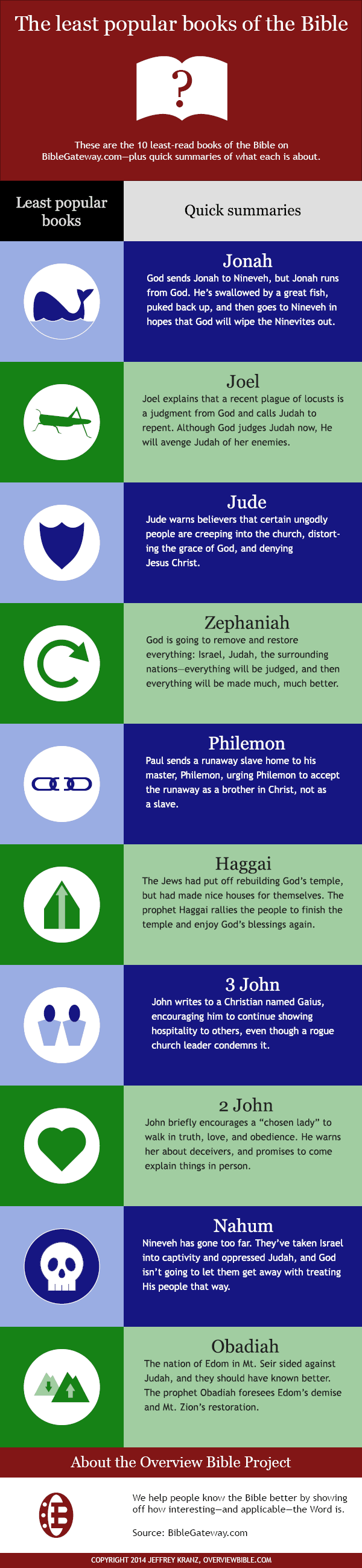
The 10 Least Popular Books of the Bible
I am surprised to see Jonah in this list but not surprised by the rest. I am also a bit surprised that Chronicles did not make the list. Go here for a bit of explanation and the source of the infographic.
HT: George Hillman.
HT: George Hillman.
May 18, 2014
Holman Bible Atlas

May 17, 2014
Free Book: Theological Interpretation of the New Testament
This week only you can get Kevin J. Vanhoozer’s Theological Interpretation of the New Testament for free. You will need to provide your email and sign up to receive emails from Baker Publishing. To sign up you can use this link.
HT: Greg Williams
HT: Greg Williams
May 16, 2014
Ezekiel's Temple
 John W. Schmitt and J. Carl Laney, Messiah’s Coming Temple: Ezekiel’s Prophetic Vision of the Future Temple, 2nd ed. (Grand Rapids: Kregel, 2014).
 I was excited to receive a copy of the second edition of Messiah’s Coming Temple: Ezekiel’s Prophetic Vision of the Future Temple by John W. Schmitt and J. Carl Laney in the mail. I remember working my way through this original edition in seminary. It was the most comprehensive examination of Ezekiel’s temple that I had read and I have yet to encounter anything to surpass it.
The original edition was published in 1997. This second edition does not include a new forward so I am not sure how much has changed. The publisher notes that, “this newly expanded work [is] based on extensive research and discussions with leading Jewish leaders and rabbis in the United States and Israel.” But this is rather vague. I can say that the original edition’s 192 pages has been expanded to 248 (not 224 as noted by Kregel) and that there are three new chapters: Ezekiel’s Temple and Archaeology, Predictions of a Different Temple, and Can Sacrifices Be Part of a Future Temple? There are also more figures/maps (from 15 to 22), photographs (from 10 to 11), and the addition of six charts. Although I have only had the opportunity to scan through this updated edition, everything that I have seen so far indicates that it remains the go-to resource for studying Ezekiel’s temple.
You can read an excerpt here.
May 15, 2014
May 14, 2014
Calvin and the Pastor/Scholar
See Philip Ryken's post on Calvin and the need for pastor/scholars here. Here is one paragraph from the post.
"Calvin’s example as a pastor-scholar is instructive today. For pastors, his life serves as a call to work hard in ministry, giving our best efforts to understanding the Scriptures. For parishioners, Calvin’s ministry can help us understand the God-given calling of our pastors. In devoting their time to prepare for preaching, they are not serving themselves but Christ and His church."
May 13, 2014
May 12, 2014
Biblical Word Versus. Theological Concept
See Christopher Cowan's helpful discussion on biblical words and their relation to theological concept here. I am grading some biblical theology papers right now where many fail to either discuss the relevant terminology or to only discuss the passages where the terminology occurs and thus ignoring other passages where the concept but not the terminology occurs.
May 9, 2014
May 8, 2014
Recovering Eden: The Gospel according to Ecclesiastes

May 7, 2014
May 6, 2014
May 5, 2014
A Review of Chisholm's Commentary on Judges and Ruth

A number of years ago I had the opportunity to take a class that covered Judges taught by the author of this book. In fact, I believe that the class notes were an earlier version of this commentary. The class was excellent. I appreciated Dr. Chisholm’s careful handling of the text combined with his interest in homiletical presentation.
These two emphases are reflected in this commentary on Judges and Ruth as well. The commentary on Judges begins with a fairly thorough introduction of 89 pages. Two parts in the introduction are noteworthy. First, the section on the chronological problems associated with the rules of the various judges was very good although I do not agree with the proposed solution. Second, the section on the “modern proclamation of Judges” is helpful for those involved in preaching and teaching this challenging book. Here the author discusses the exegetical idea, theological idea, homiletical trajectories, and primary preaching idea for each section. The introduction to Ruth is 33 pages. I found the discussion on literary structure interesting although I am not comfortable with using dramatic terminology (acts, scenes, etc.) since this might suggest that the genre of Ruth is theatrical and related to ancient drama (a genre that I believe postdates the composition of Ruth). As with Judges, Chisholm provides the reader help with preaching and teaching the book.
The commentary proper follows a similar format. Each section of the commentary begins with a translation (a slightly revised version of his translation from the NET Bible) that is parenthetically identified with narrative structure labels (e.g., mainline clauses, offline clauses, and quotations). This is followed by an outline, a discussion of the literary structure, and an exposition of the text. The exposition is followed by a discussion of the message and application of the passage. Here the preacher/teacher is given helpful material from which to craft a sermon or lesson. One will need to have some training in Hebrew to get the full benefit of this work though.
Overall this commentary is an excellent resource for the study of Judges and Ruth. The comments are detailed enough to be helpful but concise enough to be useful. The author is fair and balanced in his treatment of textual difficulties and carefully articulates his preference. Chisholm’s discussion of Jephthah’s treatment of his daughter is a good example of this (pp. 350-65). Also, as noted previously, this commentary is preacher/teacher friendly. Even the chapter titles have a sermonic flavor. Rather than utilizing something as linguistically sterile as “the Samson narrative” for chapters 13–16, this section is cleverly labeled, “Samson: Lion Killer with a Sweet Tooth.” There is not much to offer by way of criticism. My lone suggestion would be a Scripture index.
Anyone who is planning to preach or teach through either Judges or Ruth should consider this book, especially if he or she has some facility with Hebrew.
You can access a 25-page excerpt here.
Thanks to Kregel for providing the review copy used in this unbiased review.
May 4, 2014
Free Logos Book for May: 300 Quotations for Preachers from the Puritans
The free Logos Book for May is 300 Quotations for Preachers from the Puritans. You can also enter to win the entire 12-volume Pastorum series. Go the Logos' Free Book of Month page to enter and download your free book today!
Subscribe to:
Posts (Atom)